Why ‘complex tasks’ are where AI hype meets reality
You’ve probably seen the pattern: ask an AI to draft an email, summarize a meeting, or explain a concept, and it looks sharp. Ask it to plan a launch with dependencies, resolve conflicting stakeholder goals, or trace an analysis across multiple assumptions, and the reliability drops fast. That gap is where hype meets reality. Complex tasks aren’t “hard” because they use fancy words; they’re hard because they require sustained control over many moving pieces—constraints, goals, intermediate steps, and checks for internal consistency.
Most AI systems are optimized to produce plausible text, not to maintain a stable, verified chain of work over time. They can sound confident while quietly drifting from earlier details, inventing missing information, or making trade-offs you didn’t approve. The cost shows up in rework and risk: a plan that looks coherent can still be wrong in ways that only appear when someone tries to execute it. Treat impressive phrasing as a starting signal, not a guarantee.
What makes a task complex for an AI system
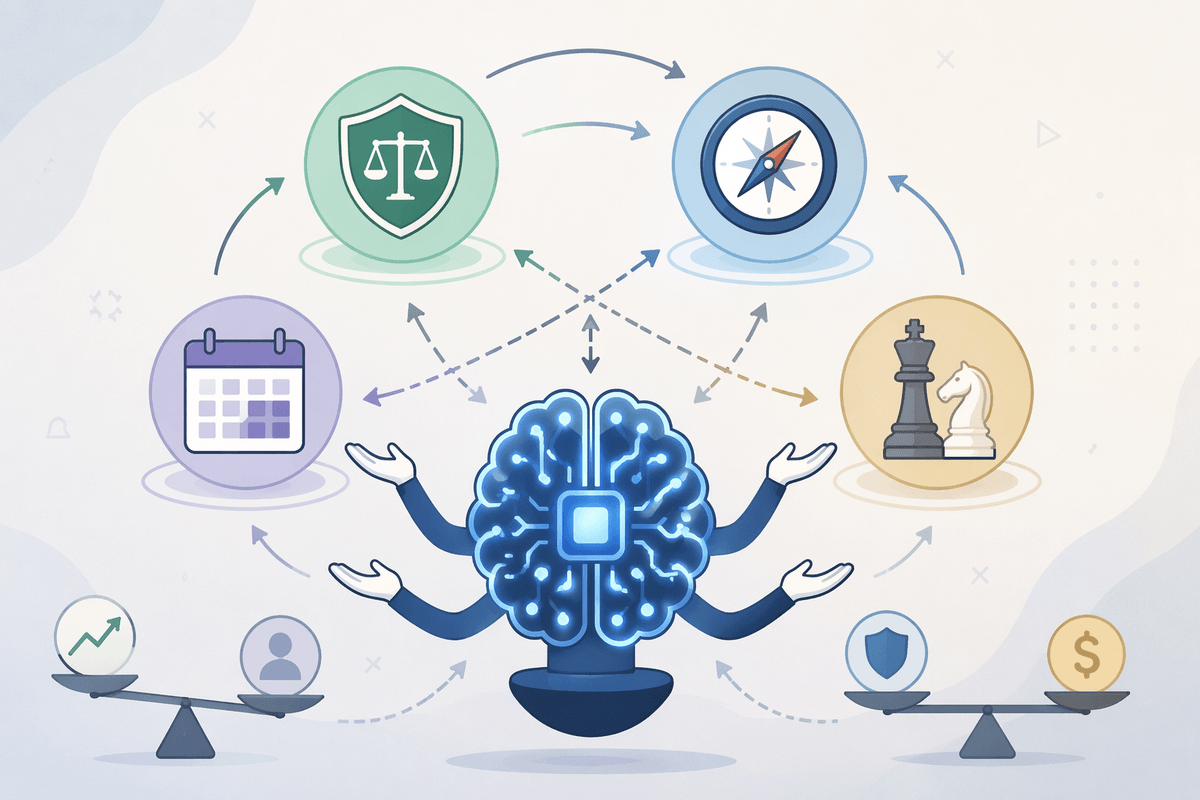
Think about the difference between “write a one-page brief” and “write a one-page brief that matches our positioning, avoids legal claims, aligns with Q3 roadmap trade-offs, and anticipates two known competitor moves.” The second request isn’t just longer. It has more constraints, and those constraints interact. Complexity shows up when the model has to keep multiple requirements “in play” while making choices that don’t obviously follow from the prompt.
Tasks also get complex when the work depends on hidden context: internal definitions, past decisions, domain rules, or proprietary data the model can’t see. If you don’t provide that context precisely, the system fills gaps with generic patterns that may sound reasonable but don’t match your reality. Add multi-step reasoning—where an early assumption shapes later conclusions—and small errors compound. The practical difficulty is that checking these outputs often costs almost as much as doing the work yourself, unless you decompose and verify it in parts.
Where AI breaks down: planning, memory, and consistency
Picture a product launch plan: goals, audiences, channels, owners, dates, and a handful of “if this slips, that moves” dependencies. AI often produces a clean-looking sequence, but planning requires more than ordering steps. It needs explicit constraints, a model of what blocks what, and a way to notice when a choice violates a rule you stated. Without that, it may create a plan that reads logically and still can’t be executed as written.
Memory is the second fault line. Even with long context windows, models can lose track of earlier details, overweight the most recent instruction, or quietly replace specifics with defaults (“two-week timeline,” “standard approval flow”) that don’t match your organization. Then consistency breaks: the same answer can contradict itself across sections—dates don’t line up, assumptions change midstream, metrics get redefined. The output rarely flags these failures; you discover them when you try to use it, which is why complex work needs checkpoints, not just a single prompt.
The illusion of competence in long, polished answers
You’ve likely seen a long AI response that “feels” complete: headings, bullets, confident rationale, even a tidy conclusion. That polish is a delivery style, not evidence that the underlying claims were checked. The model is good at producing a shape that resembles a strategy doc or postmortem, including plausible-sounding numbers, frameworks, and citations that may not exist. In practice, a single invented detail can anchor everything that follows—pricing assumptions, market sizes, dependency risks—and the rest of the document will still read smoothly.
The failure mode is subtle because the tone stays consistent even when the logic doesn’t. It will define a goal one way in paragraph one and a different way in paragraph five, or recommend trade-offs without noticing they conflict with your constraints. The real cost is review time: you end up auditing each claim, which can be slower than writing a shorter, verified draft yourself.
Ambiguity and shifting requirements: the silent failure mode

A familiar moment: you ask for “a launch plan,” then realize you meant “a launch plan for one segment, with a hard date, and no new engineering work.” Humans ask clarifying questions; an AI usually makes a best guess, commits to it, and keeps going. If the prompt leaves room for interpretation—who the audience is, what “success” means, which constraints are non-negotiable—the output can look decisive while solving a different problem than the one you actually have.
Shifting requirements make this worse because the model tends to prioritize the latest instruction, even when it conflicts with earlier constraints. You’ll see subtle drift: “no paid channels” becomes “light paid retargeting,” or “legal reviewed” becomes “legal-friendly language.” The practical difficulty is that these are not obvious errors like a wrong date; they’re governance failures. If the work will be executed by multiple teams, ambiguity creates rework and stakeholder churn, and the AI won’t reliably warn you that the spec has changed.
The safest pattern is to force decisions into the open. Ask it to list assumptions, define terms (“launch,” “MVP,” “enterprise”), and restate constraints before generating deliverables. When requirements change, have it produce a diff: what changed, what breaks, and what needs re-approval. That turns “silent” failure into something you can review like any other spec change.
When AI helps anyway: use it as a tool, not the driver
In practice, AI can still be valuable on complex work when you treat it like a fast assistant for bounded pieces rather than a planner of record. Have it generate options you can choose from: three positioning angles, five risks you might be missing, a draft agenda for a cross-functional meeting, or a set of questions to ask Legal and Security before you commit to a date. The output is most reliable when you can evaluate it against something external—your roadmap, your metrics definitions, your constraints—without needing the model to “remember” them flawlessly.
The working pattern is to keep ownership of the decisions and use the model for throughput: turn messy notes into a structured brief, rewrite for different audiences, propose test cases, or translate a strategy into a checklist with owners and acceptance criteria you then edit. You still pay for review, and you should assume any factual claim, estimate, or dependency mapping needs verification. When the cost of being wrong is high, the model’s job is to accelerate drafts and surface gaps, not to finalize the plan.
Practical guardrails for complex work you can’t avoid
A common real-world setup is having to ship a plan fast, with incomplete inputs and multiple reviewers. Start by narrowing the model’s job: ask for a checklist, risk register, test plan, or stakeholder questions—not “the whole strategy.” Make it restate constraints and assumptions first, then generate one artifact at a time with clear acceptance criteria. If it can’t point to where each decision came from (a doc, metric definition, or policy), treat it as a suggestion, not an answer.
Build verification into the workflow. Use a second pass to hunt for contradictions: dates, owners, definitions, and “non-negotiables.” Require a diff when you change requirements, and keep a single source of truth outside the chat (doc, ticket, spreadsheet) that you update manually. The cost is overhead: decomposition and review take time. The benefit is you catch failures before they become execution work, not after.