Why robot soccer is a surprising mobility testbed
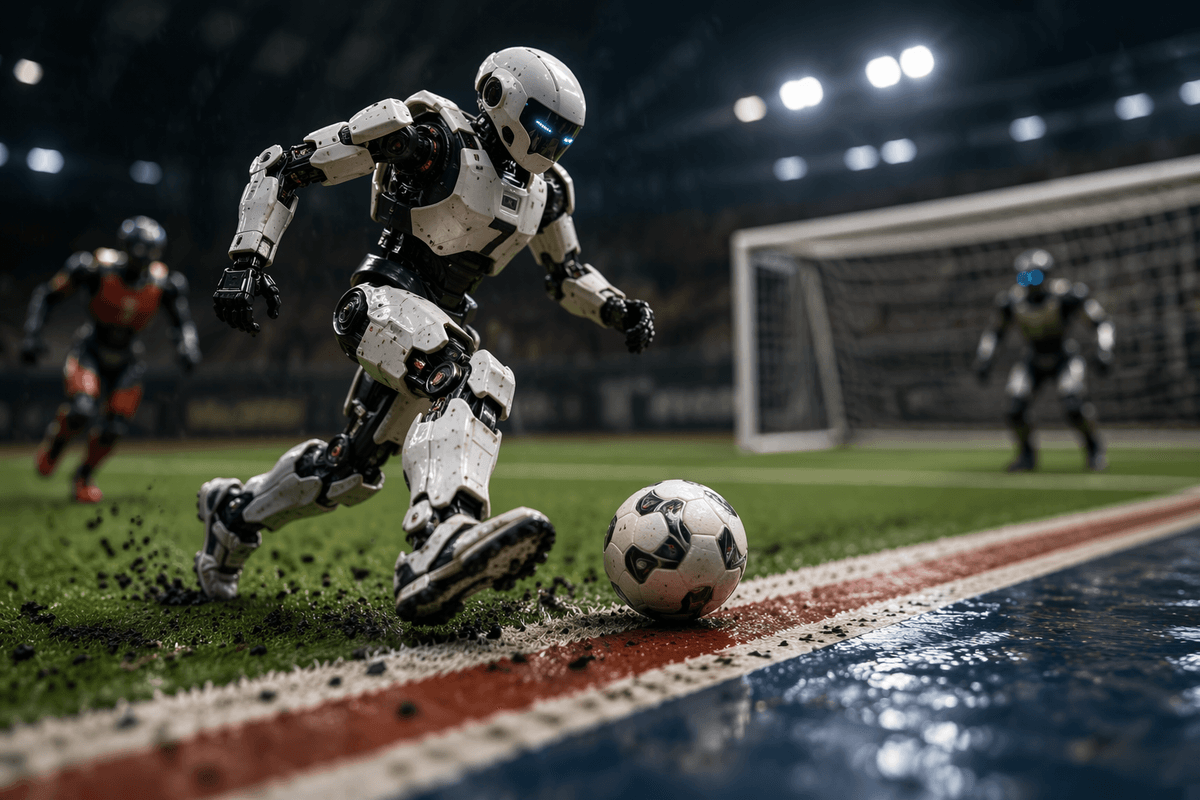
Robot soccer looks like a stunt until you watch what it forces a robot to do repeatedly: accelerate, decelerate, cut, and recover while tracking a moving target and avoiding collisions. A lab demo can choose the cleanest patch of floor and replay a scripted path. A match doesn’t cooperate. The ball rolls into seams, turf pellets, glossy paint, and worn spots where traction changes without warning, and the robot still has to keep its feet under it.
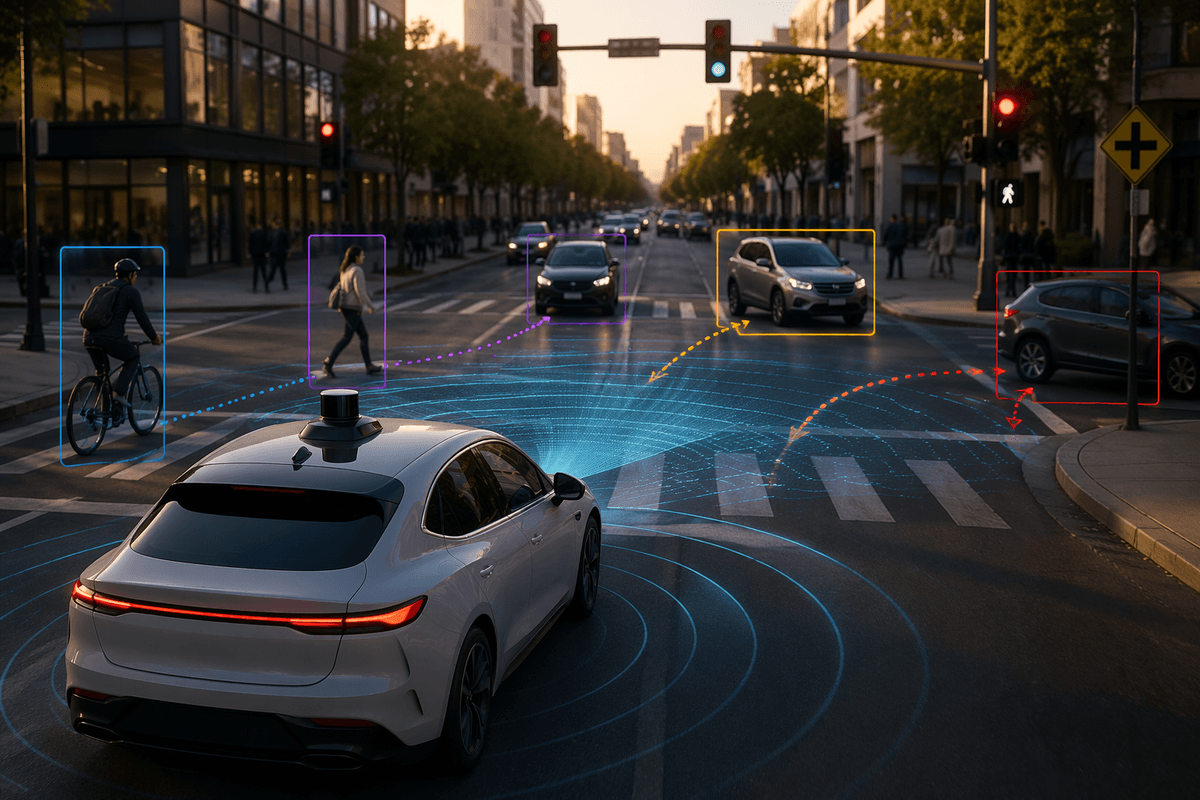
That mix makes soccer a compact “mobility stress test” because body control and decision-making are coupled every second. A small perception delay becomes a late step; a late step becomes a slip; a slip becomes a fall unless the controller can catch itself. The same loop—sense, place a foot, shift weight, re-plan—shows up in warehouse robots around people, delivery robots on uneven sidewalks, and field robots stepping over roots.
It’s not a perfect proxy for the outdoors. Fields are usually bounded, weather is controlled, and many leagues standardize surfaces, which can hide problems like mud, deep gravel, or steep grades. Hardware also matters: a platform that survives soccer may do so by being overbuilt, power-hungry, or expensive. The value is less “soccer equals real world,” and more that match pressure exposes whether a mobility stack can handle continual, unscripted disturbance without falling apart.
The mobility gaps that show up only in real matches
A familiar pattern shows up once the whistle blows: the robot that looked stable in trials starts “micro-failing” in ways that don’t register in highlight reels. It hesitates for half a beat when the ball changes speed, widens its stance to feel safe, then loses the chance to intercept. Those are mobility gaps, but they originate in the full loop—state estimation drift, contact timing, and foot placement all interacting under a clock.
Real matches also expose recovery quality, not just nominal walking. Light bumps, partial slips, and toe catches happen constantly, and a controller that can survive one shove on a test rig may still fail when the shove arrives mid-turn with one foot already unloading. You see robots that can sprint only if they never need to brake hard, and robots that can cut only if they don’t need to see and plan at the same time.
The practical limitation is that teams often tune for a specific field and shoe/sole setup. Performance can look “solved” until you change turf infill, humidity, or battery voltage, and then the same gait becomes brittle.
What soccer demands from a robot’s body and feet
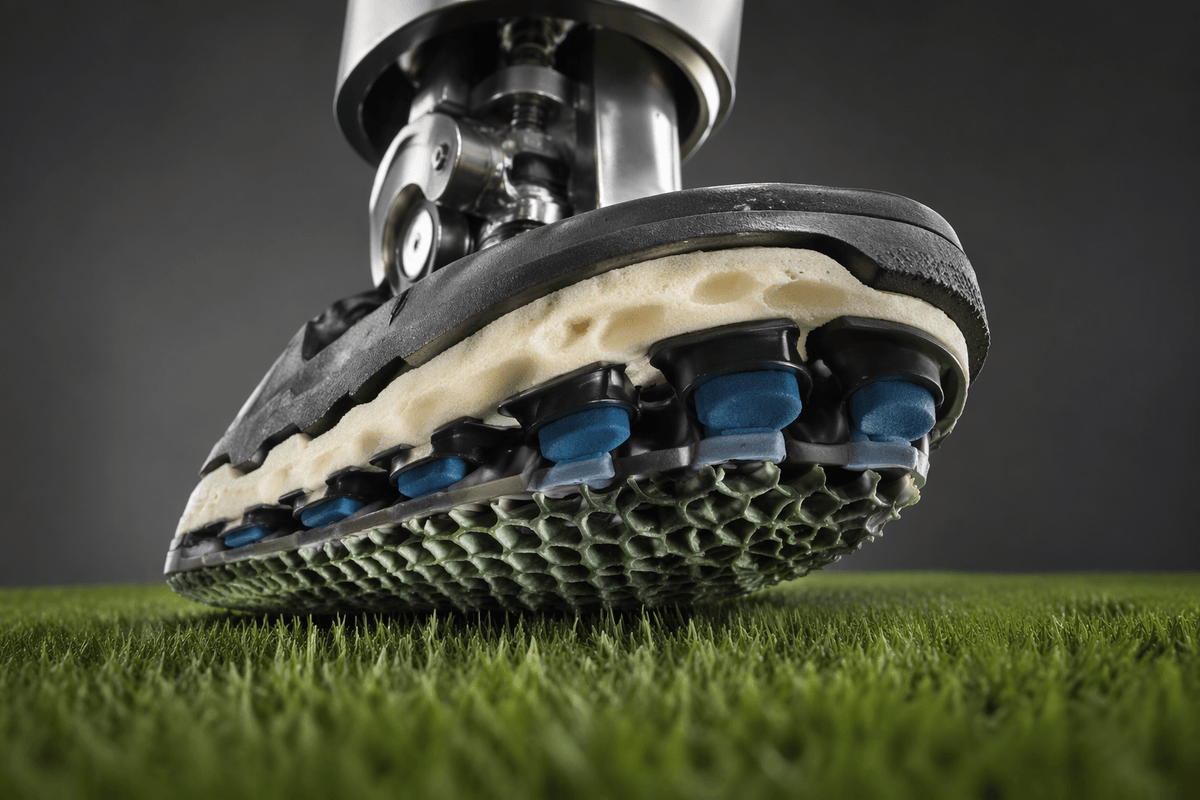
Watch a robot chase a rolling ball and you can see why “mobility” isn’t just about having legs. The body has to stay controllable while the center of mass moves aggressively: quick starts, hard stops, and side-steps that load the ankle and hip differently every stride. That means enough torque and range of motion to place the foot where it needs to land, plus a trunk that can counter-rotate so the robot doesn’t tip when its head and arms swing for balance or vision.
The feet do more than provide grip. They have to tolerate imperfect contacts—heel-first touches, edge loading, stepping on a seam or turf pellet—without turning those into large yaw slips. Sole geometry, compliance, and friction profile shape whether the controller can “feel” a stable contact early, then commit weight confidently. Too stiff and the foot skates; too soft and energy disappears into squish, slowing reaction.
The soccer-optimized hardware often trades endurance and cost for agility. High-torque actuators, durable soles, and protective structures add weight and power draw, so a platform that looks great for a short match may not translate cleanly to an all-day field robot.
Control strategies that survive traction changes mid-play
You can feel the traction problem even as a spectator: one step bites cleanly, the next lands on a slick patch and the same turn suddenly over-rotates. Controllers that hold up in matches treat contact as uncertain rather than guaranteed. They fuse IMU data, joint sensing, and foot force (when available) to estimate slip early, then reduce the demand—shorter steps, lower push-off, and less aggressive yaw commands—before the robot “commits” its weight to a bad contact.
On top of that, teams lean on whole-body control that keeps balance constraints explicit: keep the center of mass inside a safe region, regulate angular momentum, and allow the upper body to counter-swing when the feet can’t. A common survival move is to switch behaviors quickly: from a sharp cut to a controlled shuffle, or from tracking the ball to “save the stance” for two steps.
Conservative slip handling can make a robot look cautious, and without good sensing, you end up tuning for worst case, leaving speed on the table.
Training and sim-to-real: why soccer helps generalization
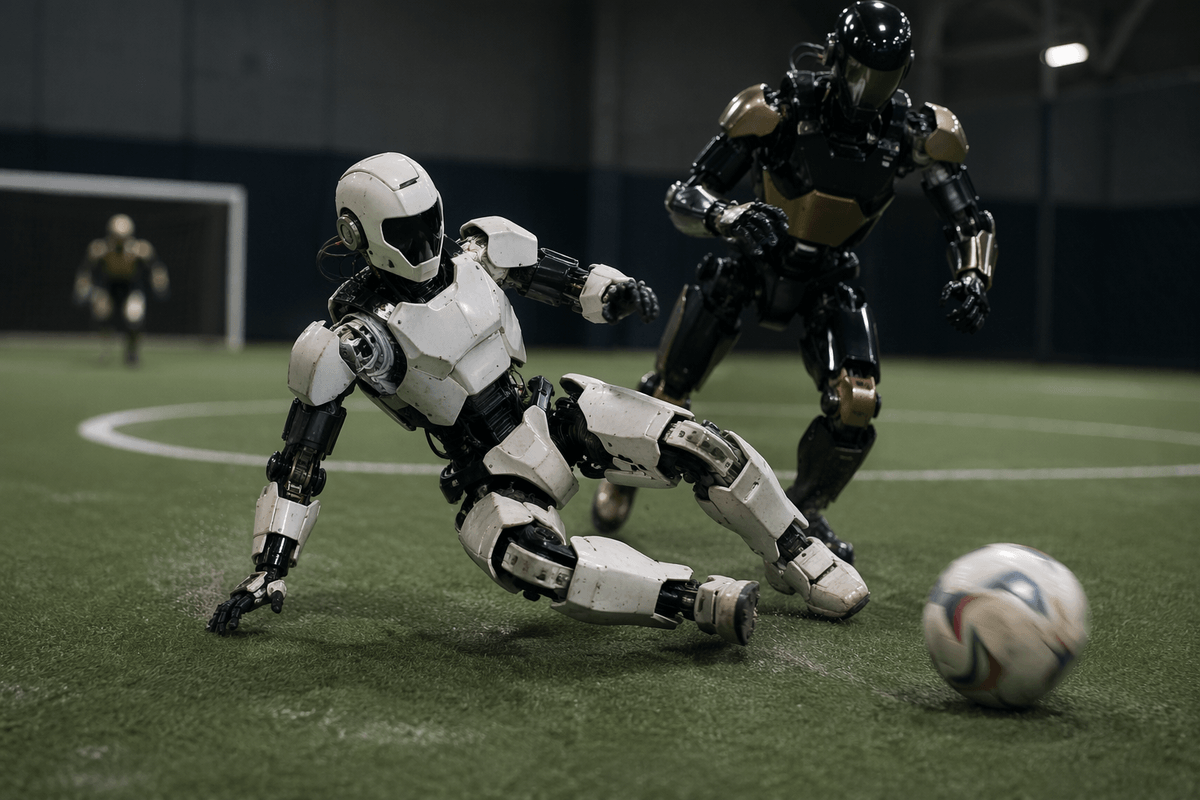
In training, the tempting move is to perfect one gait on one surface until it looks “done.” Soccer punishes that approach because the robot keeps encountering small shifts it can’t predict: ball speed changes, opponent bumps, foot contacts that are slightly off, and traction that varies across a few steps. That variety creates a dense stream of near-failures, which is exactly what you want if your goal is a controller that generalizes. Policies and planners trained with domain randomization—friction, compliance, latency, mass distribution, even mild sensor noise—get a more honest workout when the real task keeps forcing rapid re-plans and recoveries.
It also sharpens what “success” means. If sim training only rewards forward velocity, the robot learns brittle tricks. Soccer rewards staying upright while turning, approaching, and stopping at the right time, which ties perception timing to foot placement and balance recovery. The practical downside is data and iteration cost: collecting enough varied falls, slips, and collisions safely can chew through hardware, batteries, and rebuild time, and teams still overfit if their “randomization” never matches the worst real patches.
Measuring multi-terrain progress without fooling yourself
A common failure mode in robot soccer write-ups is measuring the easy part: average speed on the “good” half of the field, or success rate in rehearsed drills. Multi-terrain progress shows up in the messy moments—when the robot transitions from grippy turf to a slick painted line mid-turn, or lands slightly on an edge and still completes the interception. If the metric can’t see those events, teams can improve the headline number while the robot remains brittle.
Useful measurements separate capability from tuning. Log where slips start (first detectable lateral drift), how quickly the controller reacts (steps to stabilize), and the cost of that recovery (lost time, path deviation, or aborted kick). Then force controlled variations: swap shoes, change turf infill, wet a region, or shift battery voltage, and require the same policy to play without retuning. The constraint is practicality—doing this well needs instrumentation, repeatable field “bad patches,” and enough trials to beat randomness, which is work teams often skip when chasing match wins.
How to apply soccer lessons to field robots and products
A product team can borrow soccer’s discipline without building a league robot: design mobility evaluations that mix perception deadlines with contact uncertainty. If a delivery robot must cross a curb cut while yielding to people, test it with moving obstacles and time limits, not just a flat-loop route. Bake in “field swaps” the way soccer forces them—different sole materials, slightly different loads, and patches with lower friction—then measure recovery time and mission impact, not only fall/no-fall.
The most transferable lesson is to treat footing as variable and make graceful degradation a requirement. Controllers that can downshift from sprinting to stable shuffling, or choose a safer foot placement when sensing gets noisy, tend to survive real sidewalks and farms. The constraint is cost: realistic disturbance testing burns hardware, operator time, and iterations, and a solution that wins on turf may still fail on mud unless you prove it across surfaces you actually plan to ship.