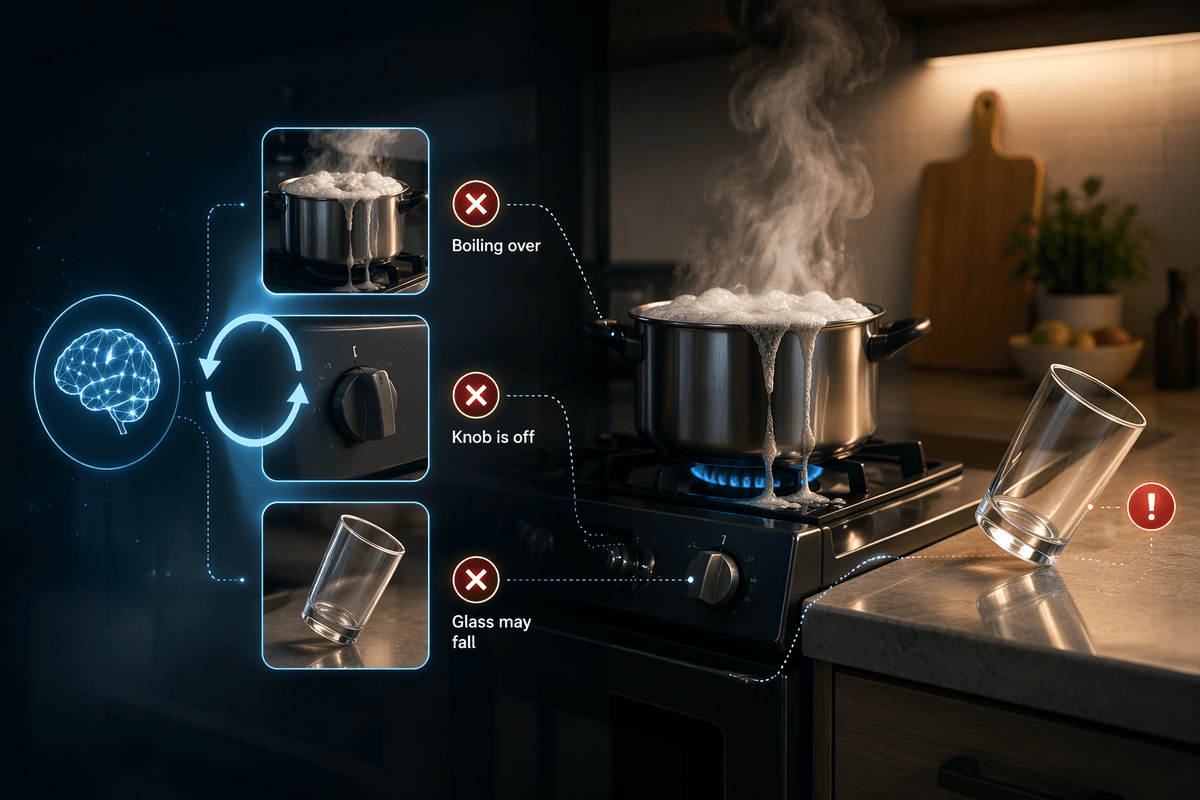
Why vision-language is changing scene understanding fast
Teams run into the same wall with vision-only systems: the model can spot “person,” “cart,” and “shelf,” yet still can’t answer the question the business actually cares about—“Is the customer blocking an aisle?” or “Did the robot place the right box on the right pallet?” Scene understanding is closer to reading a situation than listing objects, and that’s where vision-language models (VLMs) are moving fast. They can turn pixels into text concepts, relate entities (“the bag under the chair”), and connect what’s visible to instructions, policies, or queries in plain language.
That language interface changes the pace of iteration. Instead of retraining for every new SKU, uniform, tool, or rare event, teams can often prompt for open-vocabulary labels, generate grounded descriptions, or search video with natural-language queries. It also helps bridge stakeholders: the same model output can support operator guidance, incident review, and analytics without building separate detectors for each task.
VLMs can be slower and more expensive per frame than classic detectors, and they can confidently describe things that aren’t there or miss small but critical details (badges, hands, subtle hazards). The shift is real, but the practical question is where language meaningfully reduces custom training and rules without creating new reliability and verification burdens.
What “scene understanding” really demands beyond recognition
In practice, “scene understanding” means the system can justify a decision about what’s happening, not just name what’s in frame. That usually requires relationships (who is holding what, what is inside what, what is blocking what), roles (employee vs. customer vs. contractor), and intent-like cues (returning an item, loading a cart, tailgating a door). It also means mapping observations to a task or policy: “is this allowed,” “is this complete,” “what should happen next.”
These requirements show up as questions with hidden context: “Is the robot at the correct staging area?” depends on signage, layout, and the current job; “Is this an unsafe lift?” depends on posture plus the object’s weight class and company rules. Real scenes also carry ambiguity—occlusions, reflections, crowded shelves—so the system needs calibrated confidence, traceable evidence (boxes, masks, timestamps), and a fallback when it can’t tell. That’s where language can help structure answers, but it also raises the bar for evaluation and guardrails.
Why vision-only models hit a ceiling in messy scenes
A familiar failure mode shows up in stores, warehouses, and street scenes: the detector works in clean benchmarks, then falls apart when the camera is high, lighting shifts, shelves are cluttered, and key objects are half-hidden. Vision-only models typically learn a fixed set of labels and patterns from training data, so long-tail variation becomes a constant tax. Add a new uniform, a seasonal end-cap, or a different pallet wrap, and you either miss it or you retrain.
The ceiling is less about raw accuracy and more about brittleness around context. “Person near door” is easy; “employee propping a fire door” depends on role cues, object state, and policy. Similar actions can look identical in pixels but differ in meaning based on layout, signage, and what happened earlier in the clip.
Closing those gaps with vision-only systems usually means more sensors, more labeled edge cases, and more hand-built logic—all of which raise cost, latency, and maintenance burden.
How VLMs connect pixels to words and meaning
A practical way to think about a VLM is “shared space plus a translator.” The image encoder turns a frame into features; the text encoder turns a prompt or label set into comparable features. When those representations align, you can ask for “open box,” “damaged packaging,” or “employee badge” without predefining every class, because the model is matching concepts, not just IDs. That same alignment also supports multimodal search: “show clips where someone leaves a cart in the aisle” becomes a retrieval problem over video embeddings.
The second step is grounding: linking words back to pixels. Depending on the model, that can mean producing boxes, segmentation masks, or pointing to regions that justify a phrase like “bag under the chair.” This is where meaning becomes operational—outputs can drive rules, audits, and UI overlays—while also exposing a constraint: grounding is often coarse, and small, safety-critical details can be missed unless you budget for higher resolution, more compute, or task-specific fine-tuning.
Concrete wins: tasks where language boosts scene interpretation
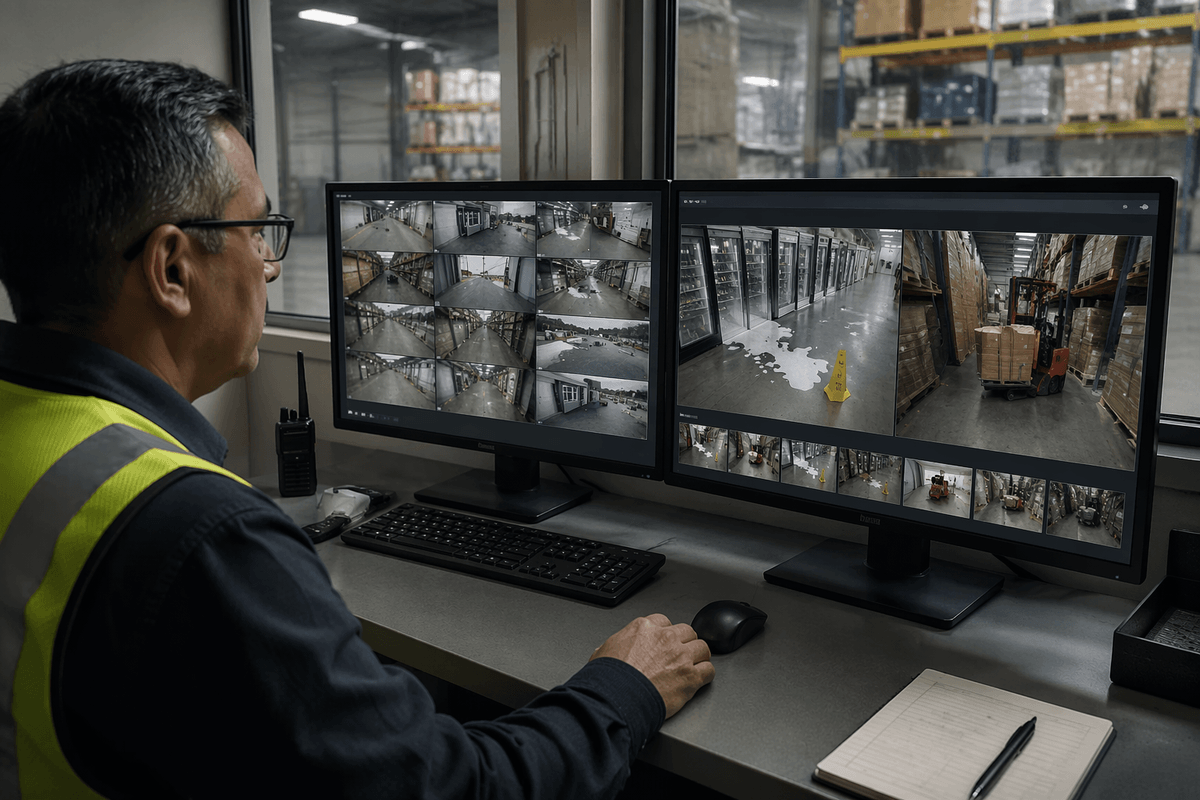
Picture the backlog you actually get from operators: “find the clip where someone tailgated,” “which pallets look mixed,” “why did the robot stop,” “is the aisle blocked right now.” Language makes these requests executable without turning each one into a new detector. In retail and security, open-vocabulary recognition plus multimodal search can surface rare events (“spill near freezer,” “customer left cart in aisle”) across days of video, then produce short, reviewable evidence snippets. In robotics and warehouses, grounded descriptions help convert messy visuals into task-relevant state: “box is on the wrong pallet,” “label is facing inward,” “tote is inside the red bin,” which is closer to a checklist than a class ID.
The practical win is fewer bespoke models and less brittle rule glue, especially when the scene changes weekly. The constraint is throughput and verification: running a VLM on every frame can be expensive, and “good-sounding” text can hide errors. Teams usually get the best results by using language for retrieval, triage, and explanations, while keeping hard gates (counts, zones, barcode reads, high-precision detectors) for decisions that trigger alerts or automation.
Choosing an approach: prompting, fine-tuning, or hybrid pipelines
The first decision usually looks like a tooling question—“Can we just prompt it?”—but it’s really about tolerance for errors and how often the world changes. Prompting works well when you need flexible labels, semantic search, or lightweight reasoning over a frame (“is the aisle blocked by a cart?”) and you can keep a human in the loop for review. It also keeps iteration fast: you can adjust instructions and label sets without collecting new data. The cost shows up in latency and variability; the same prompt can behave differently under lighting shifts or camera angles, and text outputs can sound certain even when the visual evidence is weak.
Fine-tuning earns its keep when the task is frequent, high-value, and definable with stable ground truth: your store layouts, your safety gear, your packaging damage types. It can improve grounding quality and reduce prompt brittleness, but it requires labeled data, careful eval splits by site/time, and ongoing refresh as operations drift. Many teams land on a hybrid pipeline: cheap detectors and trackers handle “always-on” primitives, while a VLM is called selectively for open-ended classification, natural-language retrieval, or an explanation layer that attaches evidence to the final decision.
Data, evaluation, and reliability: what to measure and watch
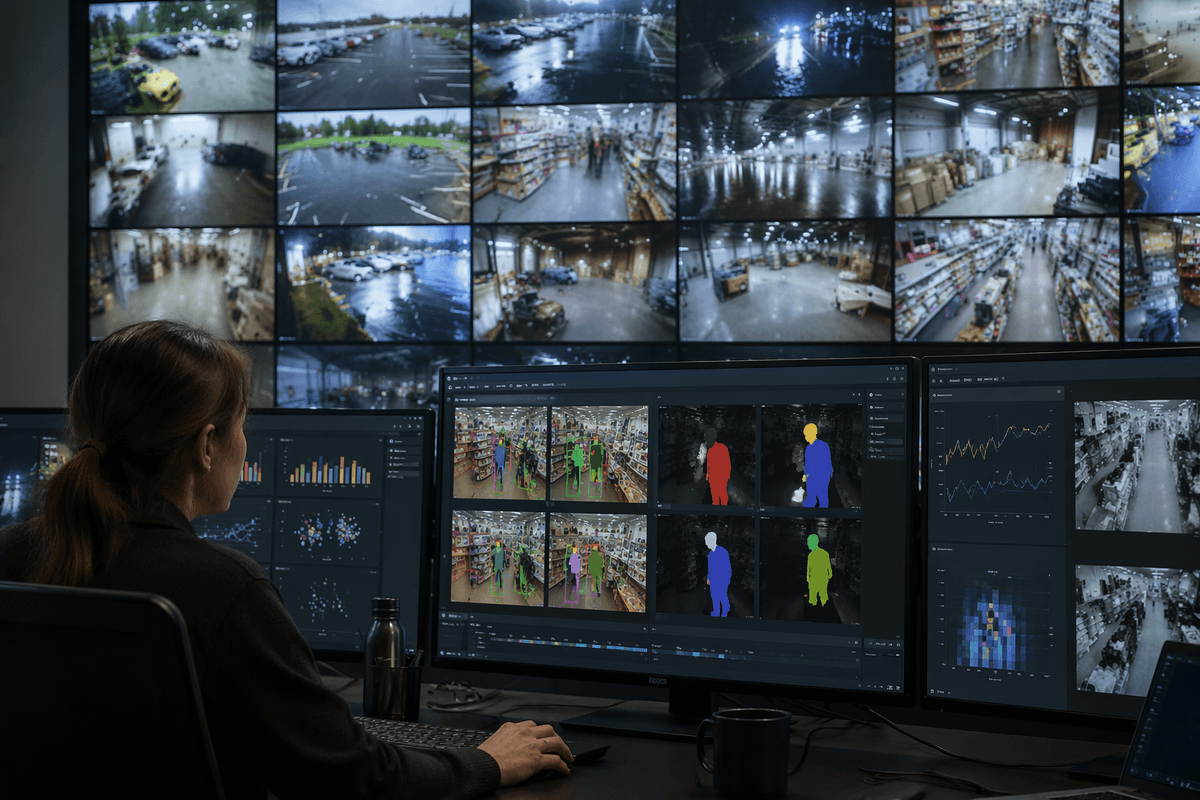
Evaluation breaks when you only score “is the caption plausible.” For scene understanding, define the decision you will take (alert, stop a robot, open a case) and measure the smallest required outputs: correct entities, correct relationships, and usable evidence (boxes/masks/timestamps). Split tests by site, camera, and time, because the most common failure in the field is domain shift—new lighting, new merchandising, new uniforms, new clutter—rather than a sudden global accuracy drop.
Track reliability signals that operators feel: calibration (does confidence match reality), hallucination rate on “must-not-invent” facts (weapons, badges, faces), and abstention behavior (how often it says “uncertain” when it should). Also measure end-to-end latency and cost per hour of video, not per frame; selective invocation can look cheap in a demo and expensive at scale. Keep a hard baseline (classic detectors or rules) as a backstop and as a drift monitor.
From demo to deployment: practical patterns and next steps
A common deployment pattern is “detect, then ask.” Run lightweight detectors/trackers continuously to segment activity (zones, people, carts, dwell time), then invoke the VLM only on candidate frames or short clips to label the situation (“aisle blocked by a cart,” “employee without hi-vis,” “mixed pallet”), generate grounded evidence, and write a short explanation for review. This keeps cost and latency tied to events, not video volume.
Before rollout, treat prompts and post-processing like product surfaces: version them, A/B test them, and log model inputs/outputs with timestamps and redaction rules. Define refusal and escalation paths for ambiguity, and decide what must be verified by a second signal (barcode scan, access log, depth sensor) before triggering automation. Budget for ongoing drift checks per site and for the unglamorous work—camera placement fixes, threshold tuning, and operator feedback loops—that often matters more than the model choice.