Why AI outputs can look like nature’s rulebooks
You’ve probably seen it: a diffusion model generates smoke that curls, clouds that billow, coastlines that jag, or textures that look like crystal growth. It can feel like the model “knows physics,” because many real-world processes produce stable visual signatures—smooth gradients, self-similar edges, and patterns that repeat across scales—so they read as rule-governed rather than random.
Most of the time, though, the model is not running equations. It’s compressing a huge pile of examples into reusable shape-and-change templates. When it needs to fill in missing detail, the safest guess is often the most common kind of continuity in the data: nearby things vary smoothly, boundaries don’t teleport, and noise averages out into coherent structure.
A generated fluid surface can “look right” while violating conservation, stability, or boundary conditions in ways that only show up when you measure or simulate forward. That’s why physics-like output is best treated as a strong visual prior: useful for plausibility and ideation, risky when you need predictions that must hold outside the training distribution.
Which “physics patterns” show up most in model generations
One common pattern is continuity: fields that change gradually in space and time. Generated heatmaps, lighting, terrain, and even abstract “state” images often show smooth gradients with crisp but stable boundaries, resembling diffusion, viscosity, and surface tension. You also see multi-scale structure—wispy turbulence, fractal coastlines, branching cracks—because many natural images contain repeated motifs at different zoom levels, and models reuse those motifs as reliable detail-fillers.
Another frequent signature is symmetry and near-conservation. Motions tend to be locally coherent (parts move together), objects keep roughly consistent volume, and textures “flow” along implied forces or contours. These cues can be extremely useful for concept art, plausible animations, and fast design iteration. They’re usually skin-deep: small violations accumulate across frames or at edges, and the output can fail hard when you demand exact constraints like mass balance, collision handling, or boundary conditions.
Data-driven mimicry or something deeper than imitation?

Think about how you can sketch convincing ripples or shading without solving Navier–Stokes or radiative transfer. You’ve seen enough examples to internalize what “usually happens,” so your hand produces something that passes a quick glance test. Generative models do the same at scale: they learn correlations between context and likely next detail, and “physics-like” emerges because the training data is full of real physical processes with consistent visual regularities.
That can still be more than surface imitation in a practical sense. A model can behave like a fast, approximate surrogate: given the right inputs, it may preserve useful invariants most of the time, generalize to nearby conditions, and produce outputs that are close enough for screening designs or proposing hypotheses. But it’s not the same as carrying an explicit notion of conserved quantities or causal mechanisms, so it can generate locally plausible structure that becomes globally inconsistent when you extrapolate, chain many steps, or change boundary conditions.
The safest test is operational: does it stay consistent under interventions? If you perturb an initial state, swap a material, enforce a constraint, or roll the system forward, does the output follow the expected direction of change—not just look similar? Measuring that costs time and tooling, which is why “looks physical” is often overtrusted in early demos.
Why diffusion and denoising objectives encourage smooth, physical structure
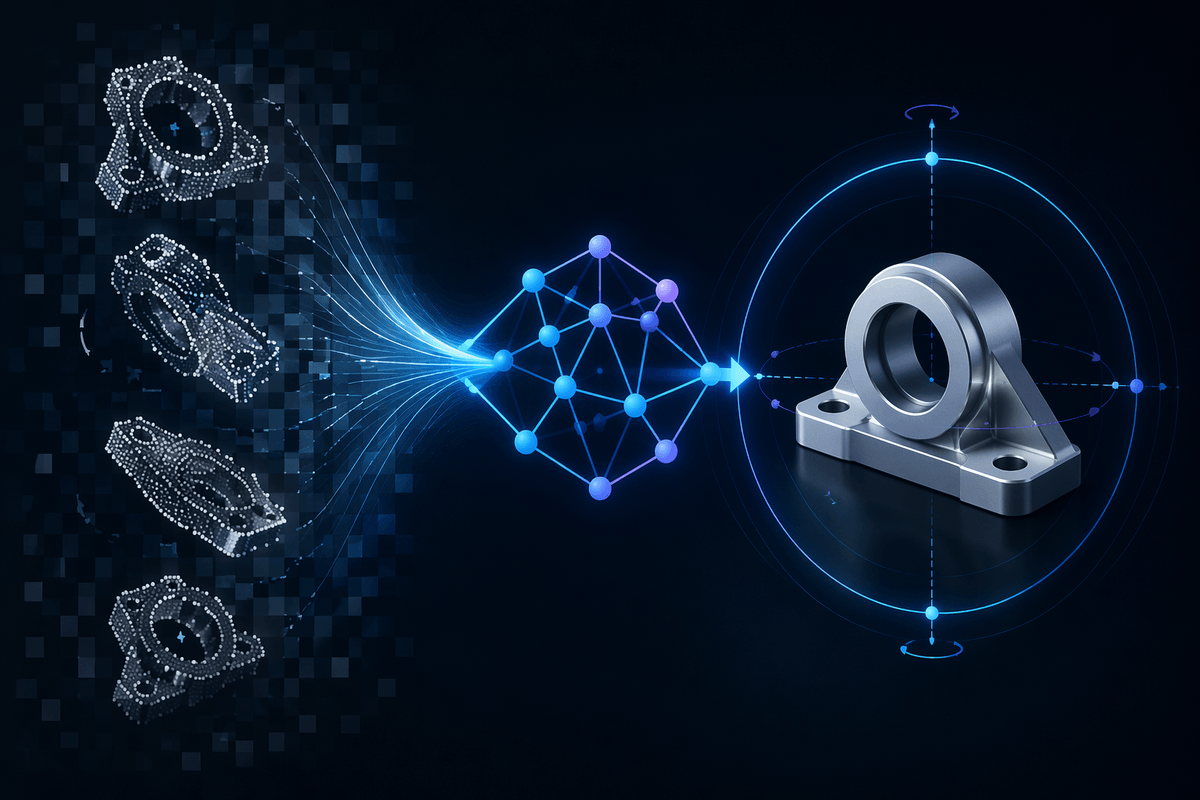
A diffusion model is trained to take something messy—an image or latent full of noise—and iteratively clean it up into something that looks like the data. That training setup quietly rewards “stable” completions: if you can explain many corrupted versions of the same scene with a single coherent reconstruction, you’ll score well. Smooth gradients, continuous surfaces, and locally consistent motion are exactly the kinds of structures that survive repeated corruption and are easiest to recover step by step.
Denoising also makes abrupt, high-frequency quirks expensive. Random speckles and sharp discontinuities are hard to distinguish from actual noise, so models learn to treat them as disposable unless the context strongly demands them. The result resembles physical regularization: like diffusion, viscosity, or averaging in measurement systems, the model tends to produce fields that vary gradually and edges that look “settled” rather than jittery.
This smoothness is a bias, not a guarantee of correctness. If the real solution requires thin shocks, brittle fracture fronts, or precise boundary-layer behavior, a denoiser may wash them out unless you add conditioning, loss terms, or post-checks that explicitly protect those details.
Training constraints that steer models toward natural-looking dynamics

In practice, the training pipeline adds “quiet” pressures that make outputs look dynamically reasonable even when no laws are enforced. Data curation filters out broken frames, sensor glitches, and rare edge cases, so the model mostly sees trajectories that already obey everyday continuity. Augmentations like cropping, resizing, and small viewpoint changes also reward features that survive mild transformations—broad flows, stable edges, and consistent lighting—while punishing brittle, one-off details.
Architectures contribute their own steering. Convolutions and attention both favor reuse of local patterns, which makes motion fields look coherent across neighboring regions. Limited resolution in latents, teacher-forced training on short horizons, and losses that average over many plausible futures all discourage sharp transitions and long-range error accumulation from being “noticed” during optimization. The cost shows up when you demand strict accounting: the model may look smooth and physical while quietly drifting in mass, energy, or contact constraints unless you add explicit checks or constraint-aware training.
When physics-inspired patterns are a feature—and when they’re a bug
You can treat physics-like output as a feature when you need fast plausibility, not strict correctness. For early design exploration, storyboarding, or generating candidate geometries, smooth flows and stable edges act like a built-in regularizer: they suppress ugly artifacts, fill missing regions in a believable way, and often preserve “commonsense” invariants (no teleporting boundaries, no wildly oscillating fields). In scientific workflows, that can be valuable as a proposal engine—something that suggests patterns worth checking with a real solver or experiment.
It becomes a bug when the task silently depends on accounting. If you’re using the model as a simulator, tiny violations of conservation, contact, or boundary conditions can accumulate until the result is unusable. The failure mode is especially dangerous because it can look more trustworthy than it is: a forecast that “flows nicely” but drifts in mass, a material that deforms smoothly but ignores yield limits, or a scene that respects symmetry while breaking causality.
The practical rule is to separate “looks stable” from “stays stable under measurement.” If you can’t afford constraint checks, rollouts, or residual tests, budget for the risk that the most physical-looking samples may be the most misleading.
How to intentionally get (or avoid) these patterns in practice
If you want more physics-like structure, give the model problems where smoothness is the easiest way to be right. Condition on low-frequency cues (coarse fields, boundary masks, keyframes), use more denoising steps or higher guidance to suppress speckle, and add light post-filters that enforce continuity (temporal smoothing, optical-flow consistency). The most reliable upgrade is external: generate candidates, then score them with a cheap “accounting” check—constraint residuals, rollout stability, or collision/boundary violations—and keep only the samples that stay consistent.
If you want to avoid being fooled by physics vibes, do the opposite: stress-test with interventions. Vary boundary conditions, swap materials, perturb initial states, and see whether the direction of change matches expectations. Use weaker guidance or inject controlled noise to reveal whether the result is robust or just a single pretty completion. The constraint is cost: running residual tests, simulators, or multi-step rollouts can be slower than generation, but it’s often the only way to separate visual plausibility from usable dynamics.
A practical takeaway: treat “physics-like” as an inductive bias
In day-to-day use, “physics-like” is best treated as an inductive bias: the model prefers smoothness, coherence, and multi-scale structure because those patterns compress well and denoise reliably. That bias is valuable when you need plausible fills, fast prototypes, or candidate solutions to rank—especially if you can cheaply verify them afterward.
It’s not, by itself, evidence of physical understanding. The practical question is whether the output remains consistent when you measure it or push it: do constraints stay satisfied, do rollouts remain stable, do interventions change results in the right direction? If you can’t afford those checks, assume you’re buying realism, not guarantees, and plan your risk accordingly.