Why “accuracy” keeps slipping in real-world face recognition
You ship a face recognition feature that looks solid in offline tests, then production brings surprises: the same user fails on a dim phone camera, a visitor badge photo matches the wrong person, or masks and hats collapse similarity scores. “Accuracy” slips because the real task is rarely the benchmark task. You’re mixing different sensors, capture distances, and incentives (users retrying, attackers probing), and your evaluation set usually under-samples the ugly cases.
Face recognition is also a pipeline, not a model. Small shifts in detection, alignment, crop margins, compression, or liveness gating can dominate the embedding quality. Even when embeddings are good, the threshold that worked in staging drifts as the population changes, cameras get updated, or enrollment photos age. Fixing it is less about hunting a better model and more about controlling the conditions you actually operate under—within latency, privacy, and storage limits.
Start by nailing the exact task, metric, and failure cost
The quickest way to stop “accuracy” from meaning everything and nothing is to name the decision you’re making. Is this 1:1 verification (unlock this account), 1:N identification (who is this person among enrolled users), or de-duplication (are these two enrollments the same person)? Each one needs different tests and will fail differently under load, retries, and correlated images from the same device.
Pick metrics that match the decision boundary: for verification, track TAR/FRR at a fixed FAR (often 1e-4 or 1e-5 for security flows); for identification, track rank-1/rank-k and false identification rate at scale. Then write down the failure cost in product terms. A false reject might mean a support ticket and churn, but a false accept can mean account takeover. That cost should drive your operating FAR, your retry policy, and whether you need step-up checks, because you can’t tune a single threshold to satisfy incompatible risks.
Data problems that look like model problems (and vice versa)
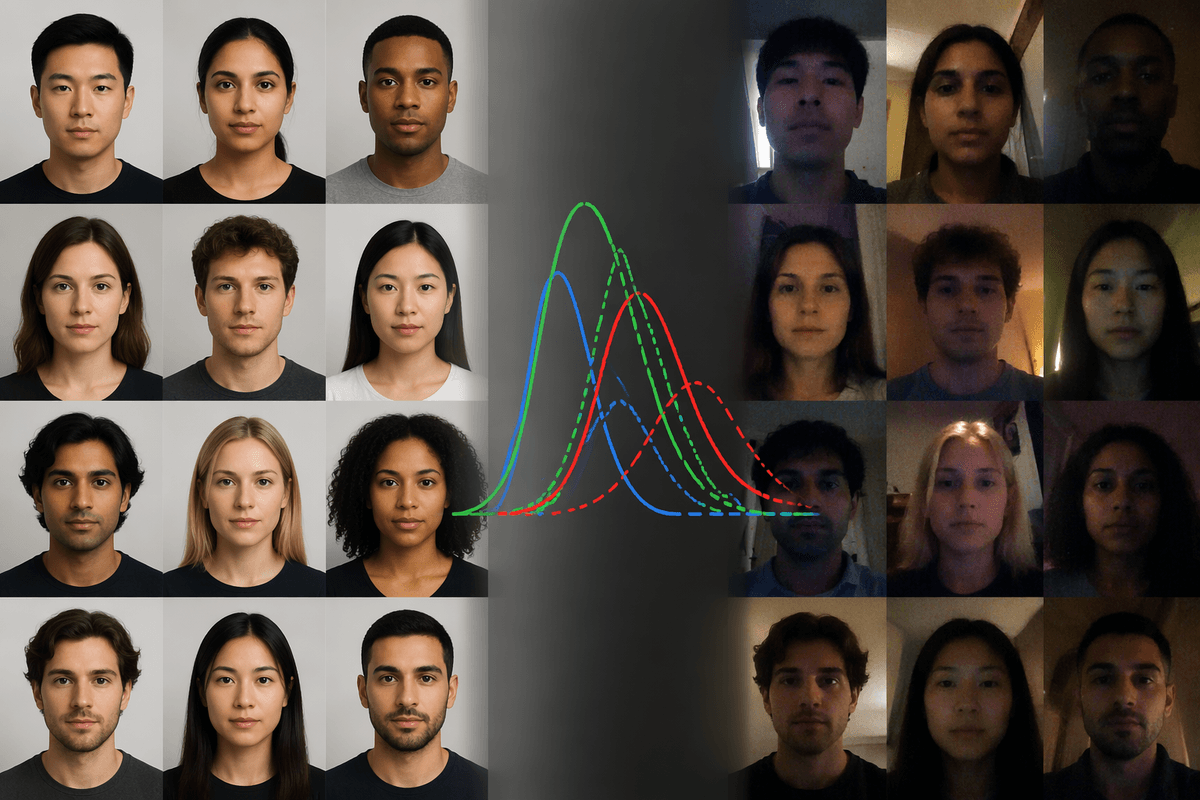
When performance looks “random,” it’s often your data distribution, not your backbone. A common pattern is a strong offline ROC curve but ugly production tails: your test set has clean, front-facing faces, while real traffic has motion blur, heavy compression, partial faces, and repeated attempts from the same person. That mismatch can look like a weak embedding model, but the fastest fix is usually better coverage: collect or synthesize the failure modes you see, and split by user/device/session so you’re not accidentally testing on near-duplicates.
The reverse happens too: you keep collecting more images, but errors stay clustered around the same situations because the pipeline is collapsing information. If detection crops are inconsistent, or your enroll photos are high-res studio shots while probes are low-res selfies, you’ll see unstable similarity scores no matter how much data you add. Before retraining, audit label noise (wrong identities, merged accounts), enforce “one identity = one person” rules, and quantify quality buckets (pose, blur, occlusion) so you can tell “needs data” from “needs preprocessing.”
Preprocessing and alignment choices that change everything
You can usually predict the “mystery” failures by looking at the pixels you actually feed the embedder. Detection confidence thresholds, minimum face size, crop padding, and JPEG recompression can swing similarity more than a backbone swap. A tight crop might help on clean selfies but punishes hair, hats, and partial profiles; a loose crop stabilizes pose but adds background that changes with environment. Pick a crop policy, then lock it down across enrollment and probe so you’re not comparing two different “definitions of a face.”
Alignment is the other lever that quietly rewrites your task. Landmark-based alignment can improve invariance to roll and mild yaw, but it can also introduce artifacts when landmarks jitter under occlusion or extreme angles. If you align, measure landmark failure rate and fall back to a safe unaligned crop rather than forcing a bad warp. Standardize color space and normalization (RGB/BGR, mean-std, gamma) and keep a close eye on camera-specific auto-HDR and beauty filters, because they can create domain shift you can’t “train away” without hurting latency and privacy constraints.
Training tactics: improving embeddings without overfitting your dataset
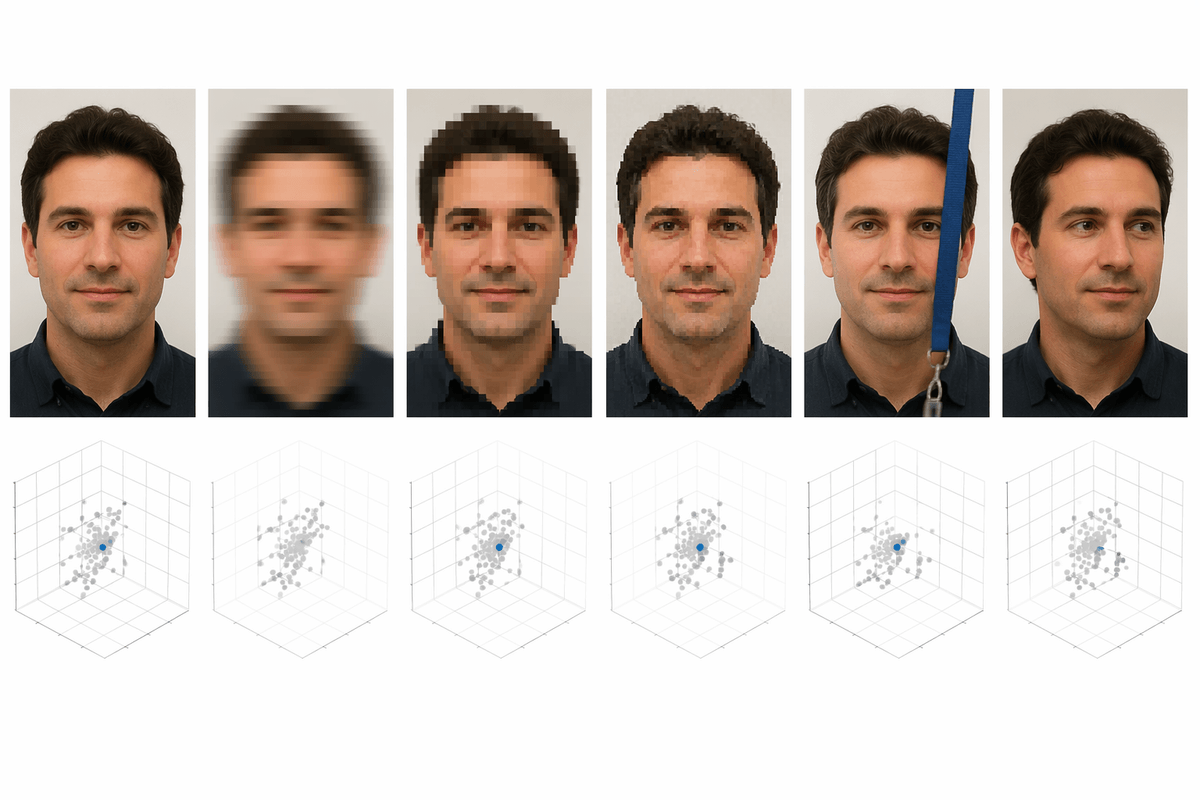
You see it when you fine-tune on your own captures: the dev set improves, then a new phone model or a different site’s badge photos get worse. The embedder has started to memorize your capture quirks (lighting, background, compression, even detector crops) instead of learning identity cues. Treat fine-tuning like a surgical change, not a default move. Start by freezing most of the backbone and only training the last block or projection head, then unfreeze gradually if you can show gains on a truly held-out domain (different devices, locations, and time windows).
Use augmentations that match production damage: motion blur, downscale-then-upscale, JPEG artifacts, partial occlusion, and mild pose changes. Avoid “fancy” color jitter that creates faces your cameras will never produce; it can hurt calibration. Hard-negative mining is usually higher leverage than more epochs: prioritize look-alike pairs and same-device near-misses, but cap how many you take from one identity to avoid overfitting to frequent users. Expect real costs: mining pairs, running extra training jobs, and re-embedding your entire gallery can dominate compute and rollout time.
Thresholds, calibration, and evaluation that survives deployment drift
Strong embeddings alone do not guarantee accurate decisions. A recognition system can perform well at feature extraction and still fail because the acceptance threshold is poorly chosen. Similarity scores are not calibrated probabilities, and their distribution shifts as detector crops change, camera pipelines evolve, or enrollment images age. For that reason, the threshold should be treated as a product setting rather than a fixed technical constant. Define it against a target false acceptance rate (FAR), then measure the resulting false rejection rate (FRR) under the retry patterns users actually follow. Identification systems require a separate process. A threshold that works well for 1:1 verification rarely transfers cleanly to 1:N search, since the distribution of top matches changes as the gallery grows.
Meaningful thresholds depend on calibration. Build separate score distributions for genuine and impostor comparisons across the conditions that matter most, including device families, deployment sites, lighting environments, and enrollment sources. When one group consistently requires a different operating point, the underlying pipeline is often the real issue, although separate thresholds can serve as a practical short-term solution. Holding back a time-based validation set also helps reveal gradual score drift that would remain invisible in a conventional identity split.
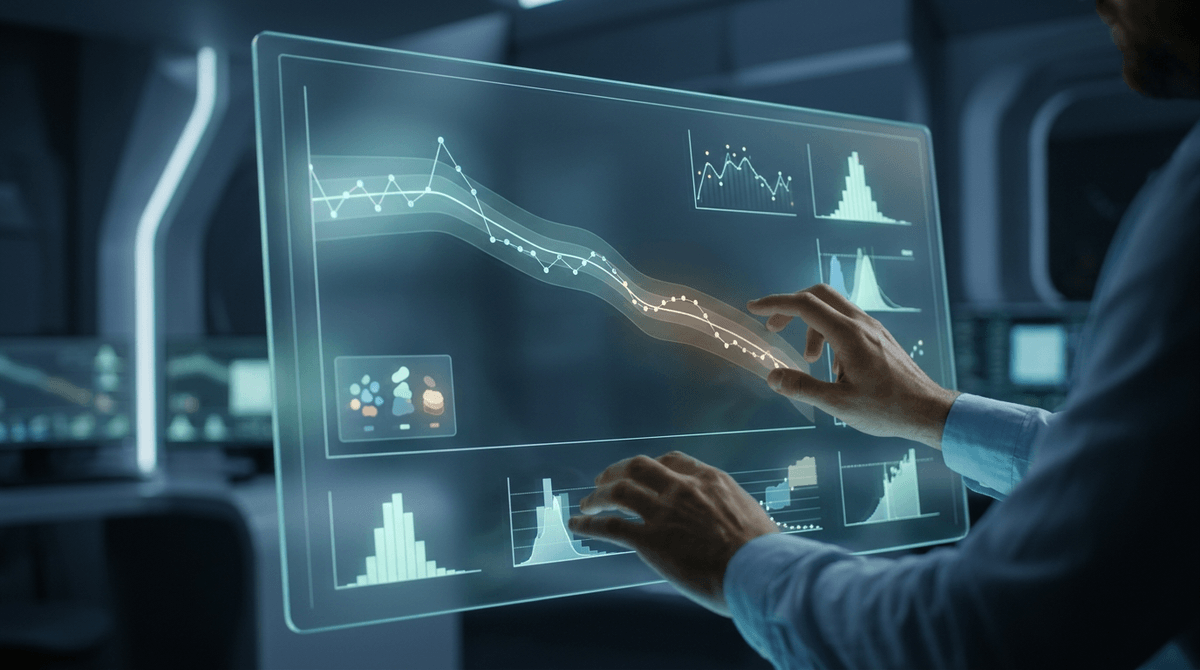
Production monitoring should follow the same philosophy. Record similarity scores alongside outcomes, including successful step-up authentication events, and track score distributions and quantiles instead of relying only on averages. Privacy constraints often rule out storing source images, so monitoring plans should be designed around retained embeddings, image-quality indicators, and hashed metadata. Those signals are usually sufficient to detect drift and diagnose changes without rebuilding the original dataset.
Fairness, edge cases, and monitoring: keeping accuracy high over time
You’ll notice complaints cluster: certain cameras, certain sites, or certain faces under the same lighting. Treat that as a fairness and reliability problem, not a PR exercise. Break metrics out by slices you can act on (device model, capture app version, indoor/outdoor, pose/occlusion, enrollment source) and also by demographic attributes if you’re allowed to collect them. If you can’t, use proxies like skin-tone/illumination estimates and face-size buckets, and confirm with opt-in audits.
Edge cases need explicit tests: twins/look-alikes, heavy makeup, glasses glare, masks, aging, and “same person, different era” enrollments. Add canary sets and run them on every pipeline change (detector update, JPEG settings, alignment tweak), because those changes often move the tails. Monitoring should track FAR/FRR estimates from sampled reviews or step-up outcomes, plus score distribution drift and detector/landmark failure rates. Expect costs: ongoing human review, policy work for data retention, and periodic gallery re-embedding to prevent quiet decay.